

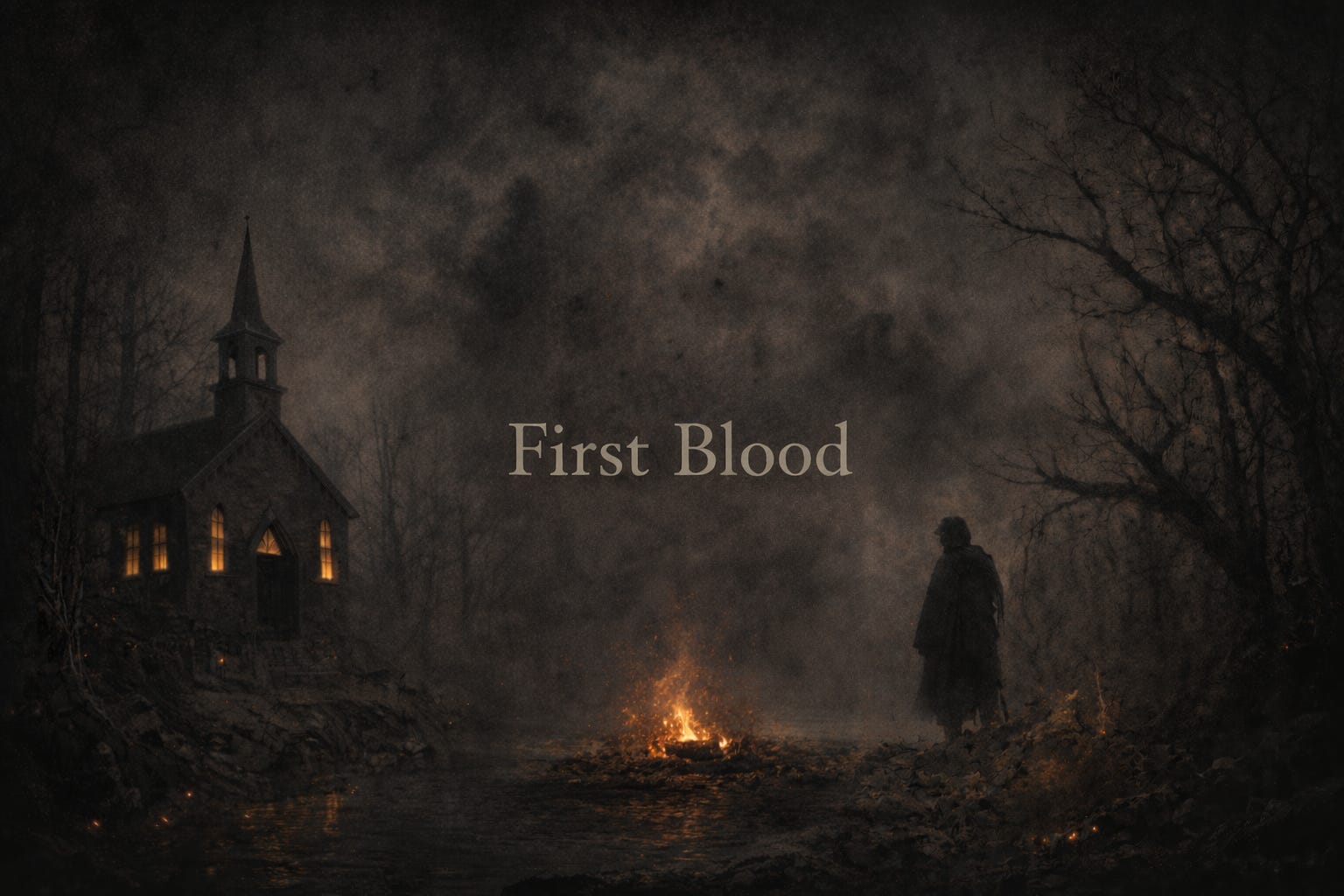
First Blood
Litany of the Light

The world did not begin in silence.
It began in naming.
Before river met shore, before root entered earth, before light distinguished itself from darkness, there was division through utterance—one thing set apart from another by the act of being known. The first boundary was not stone, nor sea, nor flesh.
It was recognition.
And from recognition came burden.
For to name a thing is not merely to identify it, but to insist upon its shape against all other possibilities. A name is a narrowing. A fixing. A violence gentle enough to pass for order.
The old traditions understood this imperfectly. The Church clothed it in doctrine. The villages buried it in custom. Mothers passed it to children in songs stripped of their origin. Men burned women believing fire could separate corruption from truth, never realizing that flame does not purify—it only reveals what refuses to leave.
There are places where these failures gather.
Places where interpretation settles too heavily upon the world and the world, bent beneath the weight of agreement, begins to answer incorrectly.
Ashcombe was one such place.
No map marks it properly. No record holds it cleanly. Those who leave carry differing accounts of its roads, its people, even its seasons. Some recall a mining village swallowed slowly by famine and hard winters. Others speak of a parish town divided by old superstitions and older grievances. A few remember only the woods.
All are correct.
None are sufficient.
Because Ashcombe was never merely a village.
It was a structure attempting to hold itself together through repetition after the reasons for that repetition had already been forgotten.
And at its center stood no king, no demon, no ancient evil waiting beneath the soil.
Only people.
People speaking inherited words with certainty they no longer understood.
People mistaking procedure for truth.
People believing that if enough voices agreed upon a thing, reality itself would eventually submit.
For a long while—
it did.
Until the world produced a contradiction the village could neither resolve nor survive.
This is not the account of heroes.
There are no victories here clean enough to survive examination. No revelation arrives untouched by distortion. Every truth enters already burdened by the shape of the one perceiving it.
What follows is therefore not a testimony.
Nor confession.
Nor warning.
It is only the nearest arrangement of events that still permits continuation.
Read accordingly.