

Chapter V - The Mayor's Table.

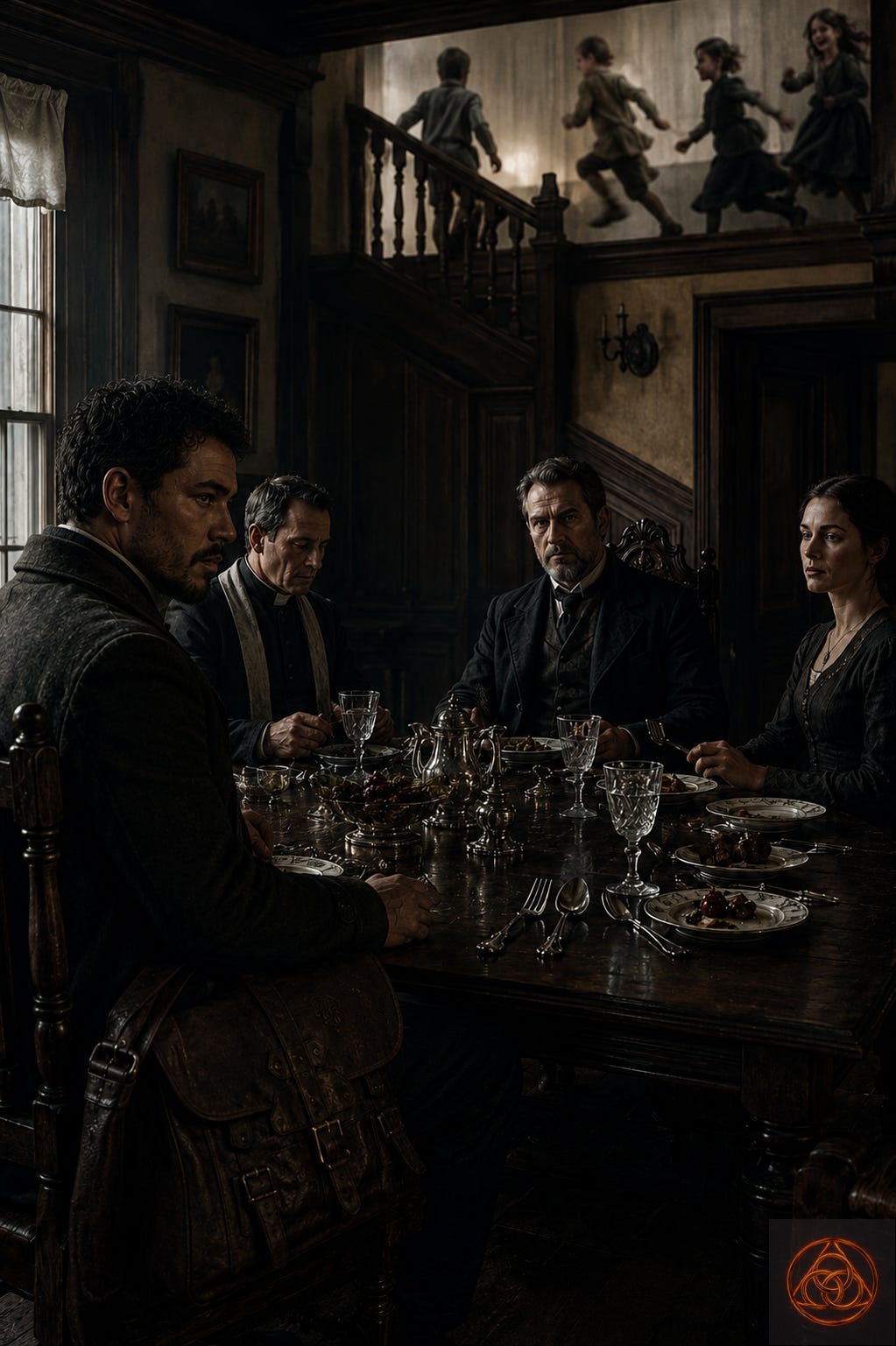
CHAPTER V, THE MAYOR’S TABLE
The knock arrived without waiting for an answer, a certainty rather than impatience. Malachi ignored the first. On the second, he closed his journal; the act of continuing had become less precise than the act of stopping.
“Enter.”
Madeline Smethers stepped inside, stopping just far enough to occupy the room without disturbing it.
“You are expected.”
It was not an invitation, nor a request. It was a statement. Malachi remained seated.
“At this hour?”
“Time has already been accounted for.”
He looked at her, neither directly nor avoiding.
“As has my consent?”
Madeline did not answer immediately. “The Mayor requests your presence. Luncheon.”
The word settled poorly. Malachi stayed where he was. Nothing in the room pressed him to move; nothing required it, and that made the decision entirely his own. He reached for the satchel, paused, measurement, not hesitation, then continued. The leather was worn but kept. He opened it not to inspect, but to acknowledge. The Codex lay where he had placed it, unshifted. The journal followed, closed but unfinished. The hex bag rested beneath them, small, unassuming, and present. Madeline’s gaze moved quickly across the open satchel, searching for nothing. It passed over the Codex and the journal, stopping long enough to be known but not long enough to name. She did not look away, nor did she look back. The moment closed without comment. Malachi secured the satchel.
“You intend to bring your work with you.”
“I do not leave it behind.”
“That may not be permitted.”
Malachi met her eyes. “It is not theirs to permit.”
Silence. Something in her expression adjusted, disagreement, or approval, or only recognition.
“They expect you as you were received.”
“I was received as I am.”
Madeline inclined her head. “Then do not keep them waiting.”
She stepped back and out. The door stayed open a breath, then shut. Malachi remained where he was, considering consequence rather than request. The room was unchanged; nothing in it would decide for him. He stood, not because he agreed, but because staying altered nothing. He took his coat and settled it over his shoulders. The satchel lay against his side, its weight familiar and unquestioned.
He stepped into the hall. The tavern adjusted to his movement rather than the reverse. Voices lowered as he passed, placed rather than silenced. He moved through the room accounted for but not acknowledged. The door opened. The village beyond was unchanged, which meant it had changed. He did not look for her. The direction had been given.
The Croft house stood apart from Ashcombe, near and yet distant, placed. He approached it as expected; the door was open before him. He crossed the threshold, and the satchel shifted against him, arrival rather than motion. The house was maintained, kept: the wood clean, the windows unwarped, the steps swept. It was order through control, not wealth, and it had been tended over time rather than recently. The difference lay in the duration. There was no recent effort here, no interruption, no correction. The house presented itself as something that had never required tending at all. The wood held no memory of weather. The glass bore no distortion of time. The threshold had been worn evenly, passage without variance, use without change.
Father Caldwell led, correctly, neither confident nor uncertain. Each of his steps was placed where it should be rather than chosen. His hand rose once, not to knock, but to confirm. The door opened. They were expected. Caldwell was already inside, seated and arranged but not at ease. The arrival was absorbed before Malachi could consider it. The air was warmer here, the warmth of habitation and structure and practice, repeated and not once. It did not shift as he entered; it adjusted to include him. The room did not receive him so much as account for him. The satchel strap tightened across his shoulder, noticed but not adjusted. Each object, table, chair, setting, held its position as a conclusion rather than a placement. Nothing had been set down recently; everything had simply remained. The silverware was laid out precisely, true silver, no plate and no imitation, and it caught the light differently, holding it and returning it in quiet, steady lines. Malachi noticed. He did not comment. He reflected the room as it held itself rather than as it was. The light did not move through it; it rested, as though instructed not to wander.
Paul Croft stood at the head of the table. He did not rise immediately. He finished his sip, set the cup down, and then stood, measured, deliberate.
“Inquisitor.” Warm, or cold; acknowledgment, in any case.
Malachi inclined his head. “Mayor.”
Marybeth stood beside him, younger, striking without ornament, composed and still. Her eyes moved over Malachi, missing nothing and lingering nowhere.
“Father,” she said softly, though not gently.
Caldwell stepped forward, eager. “Mayor Croft, I thought best,”
Paul raised his hand, finally, abruptly. “Yes. I am aware of what you thought.”
Caldwell stopped. The sentence died. He stepped back, dismissed, or simply no longer necessary. He did not look up immediately; discourtesy, or only delay. Recognition required more time here.
“Please,” Paul said. “Sit.”
They sat. The table was full but not crowded, the space measured and the distances maintained, control again. Malachi did not set the satchel aside; he kept it against him. Caldwell adjusted his chair once, then again, alignment rather than comfort. The distance had not changed and yet seemed to require correction. He did not touch the silver immediately, and when he did, he was careful to disturb nothing previously undisturbed. He ate in small sounds only, utensils, glass, restraint.
Marybeth broke the silence. “Madeline tells me you met her this morning.” Her eyes were on her plate. The question was meant to seem casual. It was not.
“Yes.”
“And what did she make of you?”
Malachi did not answer immediately. “She asked questions.”
Marybeth smiled slightly. “She does. Always has.”
Paul cut into the meal, precise and controlled. “You remained.”
“Yes.”
“The matter is resolved.”
“So it appears.”
Paul looked up, holding him. “Yet you are still here.”
A beat. “Yes.”
Caldwell shifted. “As I said, the matters of,”
Paul did not look at him. “Father Caldwell has done his duty.”
The words were neutral; the dismissal was not. Caldwell went still, silence, or removal; his presence remained while his position was gone. He sat within the conversation as something already concluded, his hands resting between the table and his lap, unsure where they were last required.
“And you?” Paul asked. “What duty remains, Inquisitor?”
Malachi did not look away. “That depends on whether the matter is concluded.”
A pause. The room held it. Marybeth set her utensil down lightly. “A woman judged,” she said. “By the Church.”
“By the village.”
“And by you.” A small tilt of the head. “What more is there to conclude?”
Malachi’s gaze shifted briefly to the silver, fork, knife, spoon, still and untouched by time, then back to her. “Resolution is not conclusion.”
Paul leaned back, measured. Relaxed, or meant to seem so. “You speak as though authority here unsettled you.”
“Authority is not my concern.”
“No?”
“No.”
Paul’s eyes narrowed. “Then what?”
Malachi did not answer; the answer was not for the table. Marybeth watched him carefully, no reaction in her face, no tightening, only a flicker. Her attention had shifted, measuring what was withheld rather than what was said.
“The village is grateful,” Paul said at last. His tone changed, smoothed, turned public. “I have written to the Archbishop. Expressed as much. Informed him the matter was handled with diligence, the Inquisitor performed his duty, and departed at first light.”
Silence. Caldwell looked at Paul, then at Malachi, then back, and said nothing. Malachi did not move. Marybeth’s gaze shifted directly to him, open and interested.
“Yet,” she said softly, “you are still here.”
From deeper in the house came laughter, children running, unchecked. A door opened. Closed. Footsteps overhead. The sound did not pass; it remained, loud, or constant; recurring, in any case, its rhythm misaligned with the movement below. The steps overhead were not traveling. They repeated, a circuit, the same distance crossed again and again. Incidental, perhaps. Or timed. The sound did not enter the room so much as settle over it: laughter, footfall, an uneven rhythm, play that was either chaotic or patterned. The house did not resist it; it carried it, through floor and wall and table, until the conversation beneath no longer stood alone. It did not obscure the room. It layered it, two structures occupying the same space, one spoken and one carried. And the second did not remain beneath the first. It rose through floor and wall and table until the room no longer held primacy. The rhythm above began to assert itself, louder, or only more complete. The intervals between the footfalls shortened. The pattern corrected itself mid-motion, unseen, insisting on accuracy. A voice, a child’s, lifted above the others, not calling but leading. The others followed, play, or sequence. The sound pressed downward, noise resolving into structure, structure seeking ground. The table did not fall silent; it became secondary. The weight in the room altered, increased, or only redistributed, as though something within the satchel adjusted to match what moved above.
Malachi listened. Sound, where there should have been failure. Present, where it had only been permitted to pass. The conversation did not pause; it was displaced. The structure held but did not resolve, the form repeating without function, the same absence he had felt beneath the chapel stone. Beneath it, something spoken, or remembered; something that resisted completion. Lay no breath upon the fire. A correction, an interruption. Waiting. Madeline did not enter. She was already there, listening.
“It would seem,” Marybeth said, “that expectation failed to move you.”
“Expectation rarely travels well,” Malachi replied.
“Yet it governs most men.”
“Most men prefer to be governed.”
“Do you?”
“Only things that do not speak.”
A pause. “And what speaks here?”
Malachi’s gaze shifted upward, toward the children. “Not what you intend.”
“You listen upward.”
“I listen where I am addressed.”
“You believe it is above you.”
“I believe it is not here.”
A pause. “Then you misunderstand the house.”
“No,” Malachi said. “You misunderstand your use of it.”
It was not an answer; it was an omission, something nearly spoken and then withheld, restraint or selection, as though the choice not to complete the thought had itself altered the room. Malachi rose, abruptly, completely. The movement broke the table, the structure, the balance of it. Paul did not stand immediately.
“Mayor,” Malachi said. “I have not departed yet.”
Paul regarded him a long moment. Then, slowly, he stood. Above them the pattern resolved. For a moment the rhythm aligned perfectly, footfall, voice, repetition, a complete structure, and the room below was given permission to say what it would not own. The laughter above swelled, bright and ill-timed and precise. An interruption, or a cover. Paul did not look at Marybeth. He did not need to. The alignment was established: one spoke, one observed, and neither contradicted the other. The pressure in the room did not come from any single direction. It was agreement.
“This house is such as mine,” he said, “not made of prolonged uncertainty. Nor is the village.”
There it was, spoken plainly. Required, perhaps. An instruction. Leave. Malachi received it. He did not accept it.
“Then perhaps,” he said, “you should be.”
The moment did not break; it thinned. Escalation, or correction; a decision made on all sides. And in that moment the satchel felt out of place against him, foreign, unrecognized, as though what it contained did not fully agree with where it had been brought. Malachi inclined his head, agreement, refusal, receipt.
“Hospitality noted. Appreciated.”
He did not move immediately, forcing the room to remain a moment longer than he wished. He did not look at Marybeth again; that was its own acknowledgment. Nor at Paul; the terms were set. He turned, quickly, or slowly, the exact point of departure mistaken for hesitation. The door closed behind him. The sound of the house did not follow. Outside, the air corrected itself. The weight returned, lighter now, aligned.
Caldwell emerged moments later, composed, or undone; misaligned, certainly.
“Inquisitor,” he said.
Malachi did not stop. Caldwell followed, too quickly, then corrected, slowing to match the pace Malachi had chosen. He maintained neither pace nor proximity for long. The open air required less of him than the house had.
“What is your intention?” The question came, inquiry, or necessity; without an answer, he would not know where to stand next.
A beat. “To remain.”
Caldwell faltered. “After what was said,”
“Yes.”
The question did not hold once spoken; it fell away, no longer requiring an answer to justify having been asked. Caldwell slowed, disagreement, or recalculation. The village reasserted itself around them. The edges returned. The distances held. Things remained placed without insisting on it. Caldwell stopped. His motion did not announce its end; it simply ceased. Malachi continued.
“Where do you return?” Malachi said. “Caldwell. Your path.”
Caldwell faltered. “The chapel.” The word did not steady him. “Matters attend.” Unfinished, or excused. Malachi did not follow it. The distance between them closed, held, then widened.
The decision.
Remain.
I enjoyed writing this chapter so very much. <3
Petty-la-belle vs His Pettiness, Pettywise.