

Chapter I - Ashcombe.
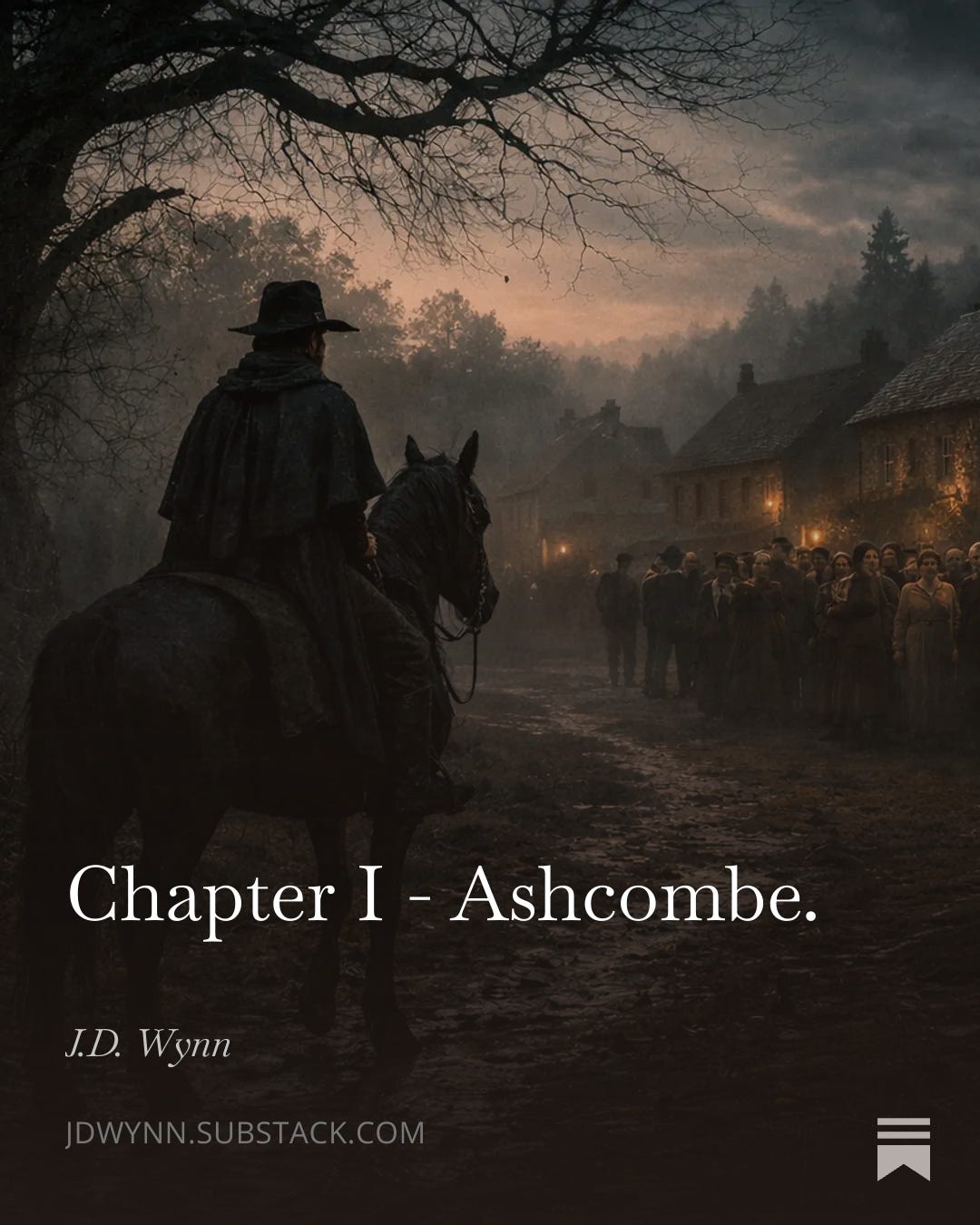
The road into Ashcombe did not welcome travelers. It narrowed long before the village came into view, hemmed in by crooked trees that leaned like old men whispering among themselves. Their branches, still bare from winter, clawed at the dimming sky. Father Malachi rode alone. Mud caked his boots and the horse beneath him, the earth soft from recent rain. Somewhere in the distance, a crow called once, sharp and solitary, then fell silent. He did not look towards the sound. He had learned long ago that some things were better left unacknowledged. The village revealed itself slowly. First, the smoke: thin, uncertain trails rising from low chimneys. Then the rooftops, sagging slightly with age. And finally, the people. They stood in the square as if waiting. Not gathered in any formal way, not arranged, but present. Watching. Watching him. Father Malachi dismounted at the edge of the square. There were perhaps thirty of them. Farmers, by the look of their hands. Women with shawls drawn tight despite the mild air. Children half-hidden behind skirts and doorframes. No one spoke. But they knew why he had come. That was always the way of it. A man stepped forward at last, broad- shouldered, his forehead wrinkled from years of pondering hard questions.
“You’re the Church man,” he said.
It was not a question.
“I am.”
The man studied him a moment longer, as though weighing something unseen. Then he nodded once.
“They were sure,” he said.
A murmur moved through the crowd, not relief, not quite fear, but something caught between the two. Expectation. Father Malachi did not move.
“They are always sure.”
“She’s below,” the man said.
“Where?” Malachi asked.
The man hesitated, just briefly, then gestured toward the chapel.
“In the church.”
The chapel stood upon slightly raised ground at the village center, its stone foundation darker than the structure built atop it, as though Saint Bartholomew had inherited bones from something older and never fully shed them. Rainwater gathered everywhere else in Ashcombe, yet the earth surrounding the church remained strangely firm, the runoff disappearing too quickly among the stones. The door opened with a low groan. Inside, the air smelled of candle wax and cold stone. A young priest stood near the altar and turned at once as Father Malachi entered. Relief passed over his face, quick and unguarded.
“You must be the inquisitor,” he said.
“Malachi.”
“Father Thomas Caldwell,” the priest replied.
“I sent word to the diocese.”
Father Malachi’s gaze moved past him. Not to the altar. Not to the pews. To a narrow, iron-banded door set into the floor beyond the sanctuary rail. Caldwell followed his gaze.
“Yes,” he said quietly.
“I thought it... safer.”
Father Malachi stepped toward it.
“How long has she been there?”
“Some days now.”
Too long. The priest moved ahead of him and knelt, pulling a ring set into the wood. The door lifted with effort, revealing a dark descent beneath the church. Cold air rose from below, not the clean cold of earth, but something older.
“Careful,” Caldwell said.
“The steps are narrow.”
Father Malachi did not respond. He descended. The catacombs were not large. A single corridor stretched beneath the chapel, its walls lined with shallow alcoves where bones had once been laid. Most were empty now, the remains long since moved or forgotten. A single lantern burned at the far end. And beneath it, she sat. Margaret Hale. Her back rested against the stone, wrists bound before her in iron, not rope. A chain fixed to a ring in the wall held her in place. Deliberate. Caldwell had followed instruction. Her head was bowed. For a moment, Father Malachi watched her in silence. The air felt wrong, not thick, not heavy, but misaligned. Like a prayer spoken with the wrong name. He stepped forward. The sound of his boot against stone echoed softly. Her head lifted. Her eyes found him immediately. And she smiled. Recognition.
“Well,” she said, her voice quiet but carrying,
“They’ve brought me below God Himself.”
Father Malachi did not answer. He stepped closer. The lantern flickered. The shadows did not follow correctly.
“You chose this place,” she continued, glancing briefly upward.
“Or was it him?”
“Does it matter?” Father Malachi asked.
Her smile deepened.
“Oh, it matters very much.”
He stopped a few feet from her. The chain shifted as she adjusted her posture, metal against stone, a small, hollow sound.
“You’ve read your book,” she said.
“The Codex.”
Father Malachi’s eyes narrowed slightly.
“You know of it.”
A soft laugh.
“Of course I do.”
She leaned forward as far as the chain allowed.
“Do you know what it calls me?”
Father Malachi did not indulge her.
“You are a witch.”
The word settled into the stone around them. Margaret closed her eyes briefly.
“As expected.”
Then she opened them again.
“And what does it call you?”
Silence. Father Malachi crouched, bringing himself level with her.
“I did not come here for questions.”
“No,” she said softly.
“You came here for certainty.”
A pause.
“Tell me,” she continued, studying him now with sharper interest,
“when it speaks of distortion, does it mention you?”
The air tightened. Just slightly. Father Malachi leaned closer.
“Who taught you?” he asked.
Her gaze did not waver.
“No one.”
A lie. But not a simple one.
“You are not the first,” he said quietly.
“And you will not be the last.”
Something flickered behind her eyes.
“You still think this is about me,” she said.
Father Malachi stood. This was enough. He turned toward the stairs. Behind him, the chain shifted again, a soft drag of iron.
“Do you hear it?” she asked.
He did not stop.
“Down here,” she continued, her voice dropping,
“It’s louder. The blood.”
Silence.
“The blood sings strongly within you.”
Father Malachi did not climb immediately. The air had shifted. He turned, not toward her, but toward the wall behind her. The stone there was different. Smoother. Deliberate. As if something had been removed. Or concealed. He stepped closer. Faint lines marked the surface, curving, intersecting, a pattern built with intention. A structure. A weave. His hand hovered. Did not touch.
“You see it,” Margaret said.
Not a question.
“Who made this?” he asked.
“I wondered when they would notice.”
“They?”
“The ones who buried your God here.”
And for a moment, everything stilled. The lantern did not flicker. The shadows did not shift. The chain hung without sound.
“Careful,” she said softly.
“Some things are not meant to be read twice.”
He withdrew his hand. And turned away. The chapel air met him like a boundary, warmer, lighter, ordered. Father Caldwell stood waiting.
“Well?” he asked.
“I require air,” Father Malachi said.
As Malachi crossed the nave, portions of the floor answered his steps differently. Most returned the expected dull resonance of aged timber and packed earth beneath. Others carried a depth that lingered half a breath too long before fading, as though emptiness existed somewhere below the visible structure. Outside, the square held its breath. Father Malachi moved past the watching villagers toward the edge of the village. The fields stretched outward, gray and still, and beyond them, Ashcombe Wood. He stopped. Closed his eyes. The world fractured. Firelight. A shape bound. Flames rising. A sound beneath it, not screaming. A rhythm. A song. His eyes opened. The field returned. Still. He exhaled. It did not leave him. A voice drifted from behind him, carrying on the cold, quiet air, sing-song and light, a child’s rhyme: “When shadow visits, God’s Good Folk...”
He turned slightly. A child stood at the center of a loose gathering. The others scattered, searching, then returned one by one. The last boy stepped forward, drew breath, and took his place at the center. A child’s game. Malachi turned away. Steeled. Resolved. He returned to the chapel and spoke with finality.
“Come. We must make this official.”
Caldwell hesitated, then produced a writ.
“It was prepared... by Bishop Benedict.”
The name lingered in the air. Caldwell dipped the quill. Paused.
“It was his hand that began this.”
He set the quill down without writing.
“They found him near the edge of Ashcombe Wood. No wound. No sign of struggle.”
He hesitated, as though the next words resisted him. Malachi waited. Caldwell’s voice lowered.
“He was lying on his back. No blood. No wounds.”
A pause.
“But no one had touched him.”
The chapel seemed to grow quieter.
“His face...”
Caldwell swallowed.
“There was no fear in it. No pain. Nothing of what a man ought to carry at the end.”
He searched for the word, then regretted finding it.
“He looked... content.”
The word hung wrong in the air.
“As though he had been given rest,” Caldwell said softly.
“Not taken by it.”
He shook his head, almost imperceptibly.
“It was not peace as God grants it.”
Silence settled. Even the faint creak of the chapel seemed to withdraw. Caldwell’s fingers tightened against the desk.
“It was... too complete.”
Silence held.
“Peace can be compelled,” Malachi said, stepping forward.
He took the quill from the visibly shaken priest and signed. Clean. Certain. He handed it back. Caldwell hesitated only a moment longer, then signed beneath. The ink settled. The writing was made. Below, Margaret Hale lifted her head. She heard it. Faint, but clear. She smiled, and began to hum
.
Powerful beginning. I'm curious where it goes from here. Persecution of witches. A dark aspect of history.